
Hard drive not recognised by the computer: causes and what to do
You connect the disk and nothing happens: it doesn't appear in File Explorer, in Finder or in Disk Management. Or it appears, but Windows asks you to format it. Before trying any software, work out which case you're in: some checks are harmless, others can make recovery harder.
This guide covers the most common causes, the checks you can do yourself without risk and the signs that point to a lab-level fault.
The most common causes
Cable, port or power
With external disks the problem is often trivial: a damaged USB cable, a faulty computer port, an unpowered hub. 3.5" disks have their own power supply: if it fails, the disk doesn't start at all.
Drive letter or partition
The disk works, but Windows doesn't assign it a letter or the partition table is damaged. In Disk Management you see it as “Unallocated” or “RAW”.
Faulty USB enclosure
Many external disks are a normal SATA disk inside an enclosure with a small board. If the enclosure board fails, the internal disk may be intact. Careful: some models (for example several Western Digital ones) encrypt the data on the enclosure board, and removing the disk isn't enough to read it.
Electronic fault in the disk
A voltage spike or the wrong power supply can burn the disk's PCB. The disk doesn't spin, or there's a burning smell.
Mechanical fault
Damaged heads or a seized motor: the disk clicks, buzzes or switches off and on. We cover this in the guide hard drive making noise.
Bad sectors and firmware
The disk spins, but the computer freezes when you connect it, or the disk is seen with the wrong capacity (for example 0 GB or a few MB). It's often a firmware problem or damaged surfaces.
Safe checks to do right away
- Change cable and port. Try a USB port directly on the computer, not on a hub. For 3.5" disks check that the power supply is the original one.
- Try another computer. If it works elsewhere, the problem is the first computer, not the disk.
- Open Disk Management (Windows) or Disk Utility (Mac) and see whether the disk appears, with what capacity and status.
- Listen to the disk. A light, steady hum is normal. Repeated clicks, whistling or total silence are not.
If after these checks the disk appears with its correct capacity and the files are visible, copy the most important data immediately to another device, before doing anything else.
External hard drive not detected on Windows 10 and 11
Open Disk Management (right-click on Start) and see how the disk appears:
- It appears with the right capacity, “Healthy” partition, but no letter. This is the simplest case: right-click on the partition, “Change Drive Letter and Paths”, assign a letter. It doesn't touch the data.
- It appears as “RAW” or Windows asks to format it. The file system is damaged. Don't format and don't run CHKDSK: files are recovered by working on a copy.
- It appears as “Not Initialized” or “Unallocated”. Don't initialise it: the partition table is lost or the disk can't read itself. If the capacity shown is wrong, the fault is in the disk.
- It doesn't appear at all, but you hear the USB connection sound or the light is on: the USB enclosure responds, the disk inside doesn't. It's an electronic or mechanical fault.
- The computer freezes when you connect it. Bad sectors or weak heads: unplug it, every attempt makes it worse.
External hard drive not recognised on Mac
Open Disk Utility and choose “View → Show All Devices”.
- If you see the disk but the volume is greyed out, try “Mount”. If it won't mount, the file system is damaged.
- If macOS shows “The disk you inserted was not readable by this computer”, don't click “Initialize”: choose “Ignore”.
- An NTFS-formatted disk on a Mac can be read but not written: that's normal, not a fault.
- First Aid should only be used on a silent disk and after copying the data: on a disk with bad sectors it can make things worse.
Internal hard drive not detected by the BIOS
If the internal disk doesn't appear in the BIOS/UEFI, with the computer off check that the data and power cables are firmly connected and try another SATA port. If it's still not detected, or is detected with a strange name or capacity, the fault is in the disk's electronics or firmware: no software can see it, it needs a lab.
If the disk held the operating system and the PC won't start, don't reinstall Windows on that disk: the installation overwrites your files.
What NOT to do
- Don't format the disk when Windows suggests it. Formatting writes over the structures needed to find the files.
- Don't run CHKDSK or “repair” programs: on a disk with bad sectors they can make things worse.
- Don't use recovery software on a disk that clicks or freezes: every hour of reading with damaged heads can scratch the surfaces.
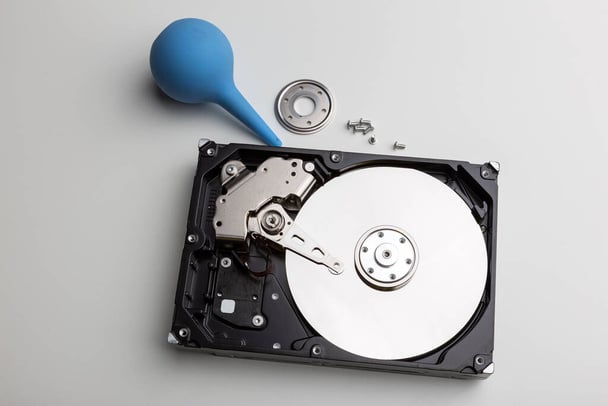
- Don't open the disk. A single speck of dust on the surface can make data unrecoverable: disks are opened only in a clean room.
- Don't put it in the freezer and don't tap it: these are legends that cause damage.
When to take it to a lab
Stop and ask for a diagnosis if:
- the disk makes strange noises, doesn't spin or switches itself off;
- it appears with the wrong capacity or freezes the computer;
- it was dropped, got wet or suffered a power surge;
- the data is important and you have no copy.
In our Genoa lab we make a sector-by-sector copy of the disk and work on the copy, not the original. That way every attempt is repeatable and the disk doesn't undergo more pointless reads.
How it works with DoctorData
- Book a pickup on book a pickup: the courier comes the next working day. In Genoa you can bring it to Viale Brigata Bisagno 6/1A.
- Lab diagnosis: €49 (within 7 days of arrival), €199 Express (72 hours) or €349 Urgent (24 hours).
- Recovery quote before any work. If you accept, the initial fee is deducted; if you decline, the disk comes back to you at no further cost.
More details on hard drive data recovery and how much data recovery costs. We answer in English.